Hale Machining: New Possibilities in Seal Groove Milling
Read more


Tübingen, October 2026. ZELTWANGER has developed a new valve technology for leak testing bipolar plates, validated it under application-relevant conditions, and filed a patent application for it. In integral vacuum testing using helium as the tracer gas, the measurement time was reduced by up to 75% in comparative measurements with a defined reference setup. At the same time, helium consumption and interfering helium background are reduced. This improves measurement signal quality, while shorter measurement times create the potential for higher throughput and reduced helium consumption helps lower operating costs.
Lower Helium Background, Faster Measurement Results
During helium leak testing, certain sealing materials can absorb the gas and release it again after a delay. This creates what is known as helium background, which masks the actual leak signal and delays the measurement.
ZELTWANGER’s new valve technology addresses this very issue. It combines a compact valve mechanism with specifically tailored materials and seal geometries. In the measurement-relevant area, helium-absorbing sealing materials are avoided. This largely prevents the delayed release of helium. This improves the signal-to-noise ratio and makes it possible to detect leak signals more quickly and clearly.
The special valve mechanism also compensates for operational changes to the sealing surfaces, thereby helping maintain consistent sealing performance even with frequent switching. This is an important requirement for use in automated production testing.
Direct Integration into the Test Fixture
Another advantage is the compact design. It allows the valve technology to be integrated directly into the test fixture at the test part. This shortens the gas paths and reduces the volume of gas remaining in lines and connections—the so-called dead volume. The measurement signal builds up faster, reproducibility improves, and the required stabilization and measurement times are reduced.
When testing bipolar plates for fuel cell stacks, valves and sensors can be positioned in a stationary arrangement in the upper test fixture. This largely eliminates the need for moving lines and additional interfaces. This simplifies the design, reduces mechanical stress as well as potential points of failure and leakage, and facilitates maintenance.
Higher Throughput with Lower Operating Costs
The new technology improves not only valve performance but also the entire testing process. Measurement times that are up to 75% shorter create the conditions for higher throughput with the same system capacity. At the same time, lower helium consumption reduces ongoing operating costs. Fewer lines, connections, and moving parts also simplify maintenance, reduce potential sources of error, and support high system availability. This results in economic advantages, particularly for large production volumes.
“Our goal is to make leak testing faster and more cost-effective for our customers without compromising measurement quality. With this new valve technology, we are demonstrating the potential for further development of the testing process. At the same time, we are reducing the consumption of helium, a valuable and limited resource. In this way, we aim to further advance high-volume industrial leak testing in terms of both technology and cost efficiency,” explains Jochen Kober, Head of Research and Development at ZELTWANGER Leaktesting & Automation GmbH.
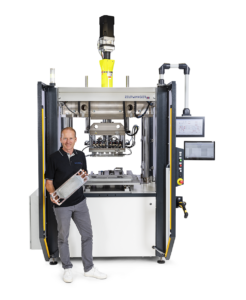
Jochen Kober with a bipolar plate in front of a leak test bench.
You need to load content from reCAPTCHA to submit the form. Please note that doing so will share data with third-party providers.
More InformationYou are currently viewing a placeholder content from Facebook. To access the actual content, click the button below. Please note that doing so will share data with third-party providers.
More InformationYou are currently viewing a placeholder content from Hubspot Embedded Content. To access the actual content, click the button below. Please note that doing so will share data with third-party providers.
More InformationYou are currently viewing a placeholder content from HubSpot. To access the actual content, click the button below. Please note that doing so will share data with third-party providers.
More InformationYou are currently viewing a placeholder content from Hubspot Meetings. To access the actual content, click the button below. Please note that doing so will share data with third-party providers.
More InformationYou are currently viewing a placeholder content from reCAPTCHA. To access the actual content, click the button below. Please note that doing so will share data with third-party providers.
More Information